Building the Resilient AI Stack
Surviving bans, outages, price hikes, and the multi-model future

The rapid adoption of generative AI has created an interesting contradiction. Organizations that spent the last two decades adopting mature engineering principles for their software infrastructure are now abandoning many of those same principles when building with AI.
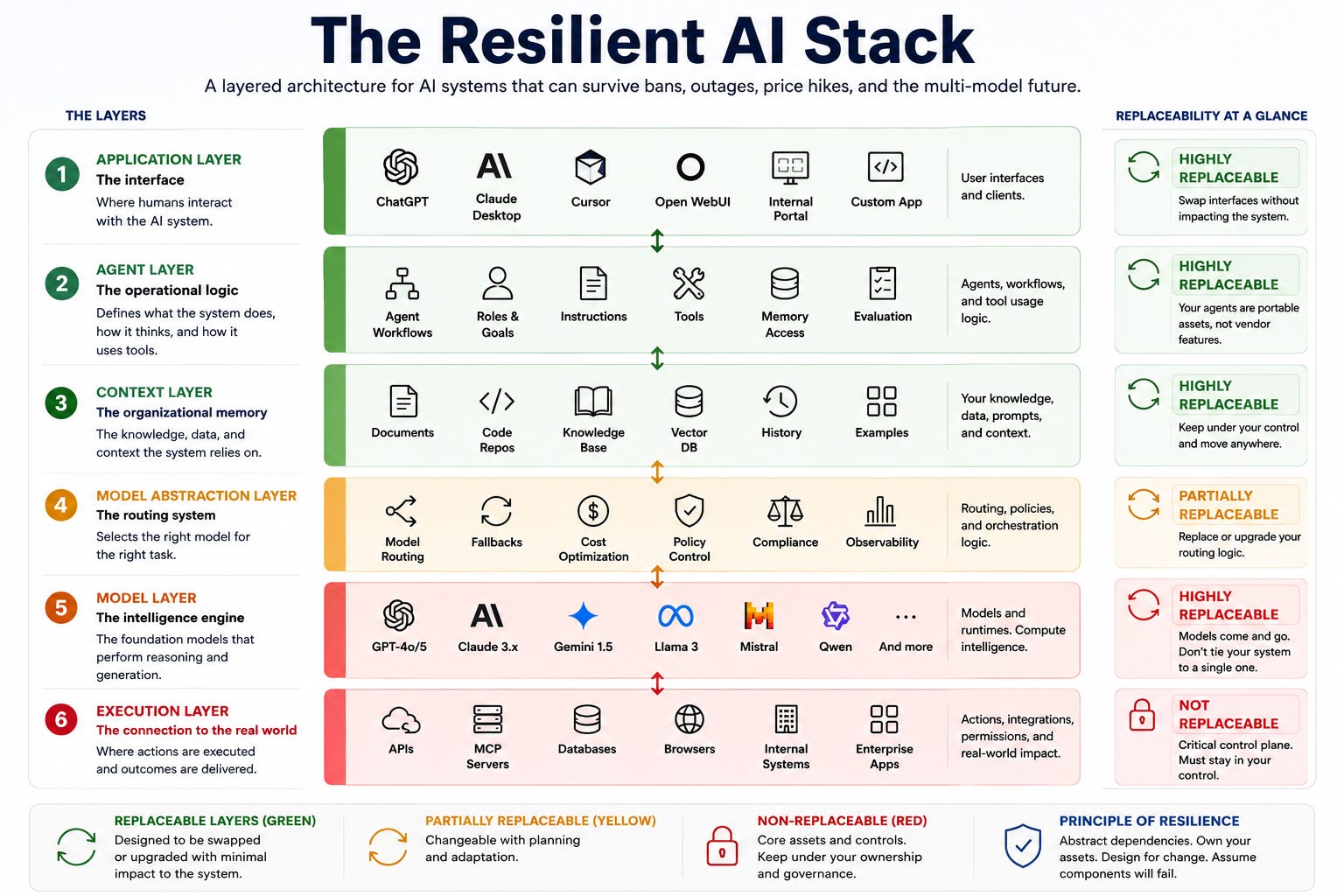
Modern software systems are designed around the assumption that individual components will eventually fail. Servers go offline, cloud providers suffer outages, vendors change pricing models, APIs are deprecated, and products reach end of life. The response was not to search for a vendor that would never fail. Instead, the industry developed architectural patterns that reduced dependency on any single component: abstraction layers, portability, redundancy, infrastructure as code, disaster recovery planning, and separation of concerns.
AI systems are now reaching the point where they require the same thinking.
The first phase of generative AI adoption treated models primarily as productivity applications. Users opened a chat interface, asked questions, generated content, analyzed documents, and received answers. In that context, dependency on a single provider was acceptable. Losing access to one application was inconvenient but not operationally significant.
That phase is ending.
AI is increasingly becoming part of the operational infrastructure of individuals and organizations. Users are no longer only prompting models; they are building persistent systems around them. These systems include specialized agents, custom instructions, knowledge repositories, integrations with business applications, automated workflows, coding environments, and decision-support processes.
As AI moves from an assistant to an infrastructure layer, the risk model changes.
A dependency on a single AI provider is no longer only a question of vendor preference. It becomes an architectural vulnerability.
Recent developments across the AI ecosystem demonstrate why this matters. Access policies can change. Accounts can be restricted. Models can be modified or retired. Prices can increase. Features can disappear. Regulatory requirements may force workloads into specific environments. Companies may discover that certain data or processes cannot leave their own infrastructure.
The lesson is not that any specific AI vendor should or should not be trusted. The lesson is that resilient systems are designed around the expectation of change.
The Resilient AI Stack
Building resilient AI infrastructure requires separating the different components that are currently bundled together inside commercial AI platforms.
Today, many AI applications combine the user interface, agent logic, memory, knowledge base, model, and execution environment into a single integrated product. This creates an excellent user experience, but it also creates concentration risk.
A more mature architecture separates these functions into independent layers.
1. Application Layer: The Interface
The application layer is where humans interact with AI systems.
Examples include ChatGPT, Claude Desktop, Cursor, Open WebUI, enterprise AI portals, and custom interfaces.
One of the most common misconceptions in AI adoption is confusing the application with the underlying intelligence layer. ChatGPT and GPT are not the same thing. Claude Desktop and Claude Sonnet are not the same thing.
The application provides the user experience: conversations, visualization, collaboration, file handling, and human approval workflows.
The model provides reasoning and generation capabilities.
In a resilient architecture, replacing the application layer should not require rebuilding the entire AI system.
2. Agent Layer: The Operational Logic
The agent layer defines what the system does.
It includes workflows, objectives, roles, instructions, planning logic, tool selection, and evaluation criteria.
This layer represents a significant portion of the value organizations create when implementing AI. Over time, companies will develop increasingly specialized agents that understand internal processes and execute complex workflows.
Those agents should not exist only as configurations inside a single provider’s environment.
A customer support agent, research agent, security analysis agent, or marketing operations agent should be portable. The underlying model may change, but the operational design should remain.
The agent is the intellectual property. The model is the execution engine.
3. Context Layer: The Organizational Memory
The context layer contains the information that makes AI systems valuable.
This includes documents, examples, procedures, prompts, previous decisions, product information, code repositories, and domain knowledge.
For many organizations, this will become one of their most important digital assets. The competitive advantage will not come from using the same foundation model available to everyone else. It will come from combining capable models with unique organizational context.
This information should therefore be managed as infrastructure.
Organizations should consider portable formats, controlled repositories, independent storage, retrieval systems, and clear ownership of their knowledge assets.
A knowledge base that exists only inside a single AI workspace creates unnecessary dependency.
4. Model Abstraction Layer: The Routing System
The AI market is unlikely to converge around a single dominant model.
Different models already demonstrate different strengths. Some perform better at software development, others at writing, long-context analysis, multimodal tasks, reasoning, or cost-efficient execution.
A model abstraction layer allows systems to select the appropriate model for each task without redesigning the entire architecture.
It also enables resilience.
If one provider becomes unavailable, too expensive, restricted, or unsuitable for a particular workload, another model can replace it.
This is also the layer that enables the integration of open-source and on-premise models when privacy, regulation, or economics require them.
5. Model Layer: The Intelligence Engine
The model layer contains the foundation models themselves: commercial models from major AI providers as well as open-source models running in private environments.
Over time, models will increasingly resemble other infrastructure components. They will improve, compete, become cheaper, specialize, and occasionally disappear.
The objective should not be choosing the single winning model.
The objective should be building systems capable of adapting as models evolve.
6. Execution Layer: The Connection to the Real World
The execution layer is where AI systems perform actions.
This includes APIs, databases, browsers, internal applications, MCP servers, development environments, and enterprise systems.
As agents become more capable, this layer becomes increasingly important because it controls what AI systems are allowed to do.
Security, permissions, monitoring, and governance should exist independently from the model provider.
The intelligence layer can change. The control layer should remain stable.
Designing for the Multi-Model Future
The current AI discussion focuses heavily on model rankings: which provider has the best benchmark scores, strongest reasoning, largest context window, or lowest cost.
Those questions matter, but they are temporary.
The more important long-term question is architectural:
Can the system survive change?
The next generation of AI infrastructure will likely not depend on a single model, provider, or deployment approach. It will combine commercial models, specialized models, open-source systems, and private deployments based on the requirements of each workload.
The organizations that succeed will not necessarily be the ones that picked the best model in 2026.
They will be the ones that built systems capable of adopting the best model available at any given time.
AI is becoming infrastructure.
And infrastructure must be designed for resilience.